With pedagogical gratitude
With Gratitude
At Pilatesprop®, our work is shaped through years of study, practice, observation, and deep respect for the teachers and traditions that continue to guide us.
With gratitude to my parents, who taught me compassion, discipline, and the importance of meaningful work.
This practice has also been profoundly influenced by my studies with the PhysicalMind Institute, Psychosomatic College, Anatomy Trains Structural Integration (ATSI), and the practice of Vipassana Meditation as taught by S.N. Goenka.
Each path has contributed differently:
movement science, structural understanding, psychosomatic awareness, meditation, and the ongoing study of the human experience.
Rather than separating body, mind, and emotion, these teachings continue to remind me that true practice is rooted in listening, humility, and awareness.
Pilatesprop® was created not only as a movement studio, but as a space for intelligent practice, personal inquiry, and lifelong learning.
With respect to all teachers, mentors, clients, and experiences that continue to shape this work.
“Listen deeply. Trust the process. Continue learning.” - Dharak D.
Anatomy Trains Structural Integration®
Anatomy Trains Structural Integration® (ATSI)
"The art, the science, and the craft" of healing with touch was developed by Thomas W. Myers
Anatomy Trains Structural Integration springs from the pioneering work of Dr Ida P Rolf, as developed, by Thomas Myers. ATSI consists of a multi-session protocol (usually 12) of deep, slow fascial and myofascial manipulation, coupled with movement re- education. ATSI is one of a number of schools that train practitioners in ‘Structural Integration’, Ida Rolf’s name for her own work. Structural Integration is practiced as an old-world craft with a 21st century comprehension of how your body structure works.
The ATSI ‘brand’ of structural integration concentrates on doing deep, lasting, and significant work, with anatomical precision, blended with movement and sensitivity to the unfolding individual experience. The ATSI‘recipe’ for structural integration is based around the “Anatomy Trains Myofascial Meridians”comcept, which are explored in the book written by Thomas Myers, published by Harcourt Brace (Elsevier) in 2001 and a 2nd edition in 2008. More Details
ATSI Approach
"...SI seeks to organize the body closely around the vertical line of gravity and lengthen it along that line"
-Tom Meyers
The ATSI ‘recipe’ for structural integration is based around the “Anatomy Trains Myofascial Meridians”concept which is explained in the book written by Thomas Myers, published by Harcourt Brace (Elsevier) in 2001 and a 2nd edition in 2008.
There are "3 Series" which is an introduction to structural bodywork and "12 series", a full Anatomy Trains Structural Integration series includes 12 sessions.
The 3 series uses the principles of Structural Integration to integrate the pelvic girdle, shoulder girdle and spine. Each session ends with gentle balancing work. Clients often leave each treatment feeling lighter or more grounded.
The 12 series is a significant Anatomy Trains SI approach which stated "to free the binding and shortening in these connective tissues, what we refer to as the fascial network, and to re-educate the body in efficient and energy-sustaining patterns".

ATSI Practitioner - Thailand

"I earnestly found myself in a deep ocean of truthfulness when I explore the world underneath the skin. ATSI pathway has developed my humble beginnings and deepened connection with myself when I practice movement as well as refined my intuition with touch.
My intention aims to encourage individuals, especially woman, to reconnect with their authentic self, to understand their body which can enhance self-awareness, be able to release emotional burdens, and promote personal growth. I love movements and bodywork. Being the first Thai ATSI practitioner, I'm enthusiastic about sharing this "Art of healing" with my community." - Dharak
Treatment programs

- 12 series (the most profound "touch technique", weekly session or twice a week is recommended)
- 3 series (introductory to ATSI with full-body treatment approach, weekly session or 3 session in a week is recommended))
Structural Bodywork
- Pilates & SI - Personalize Pilates program with body reading/ profiling and may include myofascia treatment
Before signing up for ATSI Structural Integration program, an initial consultation for new clients is required. This session includes:
- Client history & profiling (photo taking)
- Posture & functional movement assessment
- Myofascia treatment
- consultation and appointment for follow up sessions with Structural Bodywork or ATSI Structural Integration
Starting your ATSI sessions, here are some suggestions for making the most of the experience. The ATSI series is a project, a project of realigning your body, educating your kinesthetic sense, and reclaiming your whole bodily self from the many alienating influences we have in our culture. You may find that some of the following ideas are more to your liking, while others do not fit your situation – consider them all, and then take what you like. More Details


Anatomy Trains Structural Integration Aims
What is ATSI?
Anatomy Trains Structural Integration (ATSI)
Anatomy Trains Structural Integration (ATSI) is a form of bodywork that looks at the whole person. It is designed to unwind tension or strain patterns within the body and restore it back to its natural place of balance, alignment, length, and ease over a progressive series of sessions. It also treats posture, chronic pain and movement dysfunction with soft tissue treatment specific to the individual.
ATSI is based on reading and treating the Anatomy Trains Myofascial Meridians (long connected chains or lines of myofascia: muscle and connective tissue called fascia) over a series of sessions. Sessions can be delivered as a 3 series or a full 12 series. The series follow a multi-session protocol with a clear beginning, middle and end to treatment, this leads to a sense of completion for the client and often results in bringing the body back to a higher level of integrated function.
The 3 session series is excellent for those seeking a full-body treatment approach, without committing to the full 12 session series.
The first session focuses on balancing the feet to pelvis, establishing a sense of core support from below.
The second session focuses on opening the breath and balancing the diaphragms through the relationships between the pelvis, ribcage and shoulders.
The third session focuses on the spine and unifying the previous sessions to integrate the body as a connected whole.
What to expect with the full 12 series?
ATSI takes place of 12 sessions, each session covers a new territory of the body, no session is the same. Sessions can be up to 90mins, sometimes much less. Assessments are done in underwear, swimwear or what makes you feel comfortable, but it is needed to get directly to the tissues that are affecting your body and its function. Treatment can take place on the table, stool or in standing. Active participation is often required in a session, this helps you to move out of old postural patterns, movement restrictions or pain in the body, as well as bringing an overall sense of body awareness.
How often between each session?
Ideally, weekly is best. However, it also depends on the individual, everyone responds differently. Sometimes having sessions too close does not allow your body enough time to process and adapt to the new information and conversely too far apart the momentum of the process is often lost. A big part of the series is learning to listen to your body, after the first session you will know what is right for you or your practitioner will guide you.
Photographs are taken at the start and end of each session, this is so we can track any changes in your structure, pattern or movements. Photos are given at the end of the series.
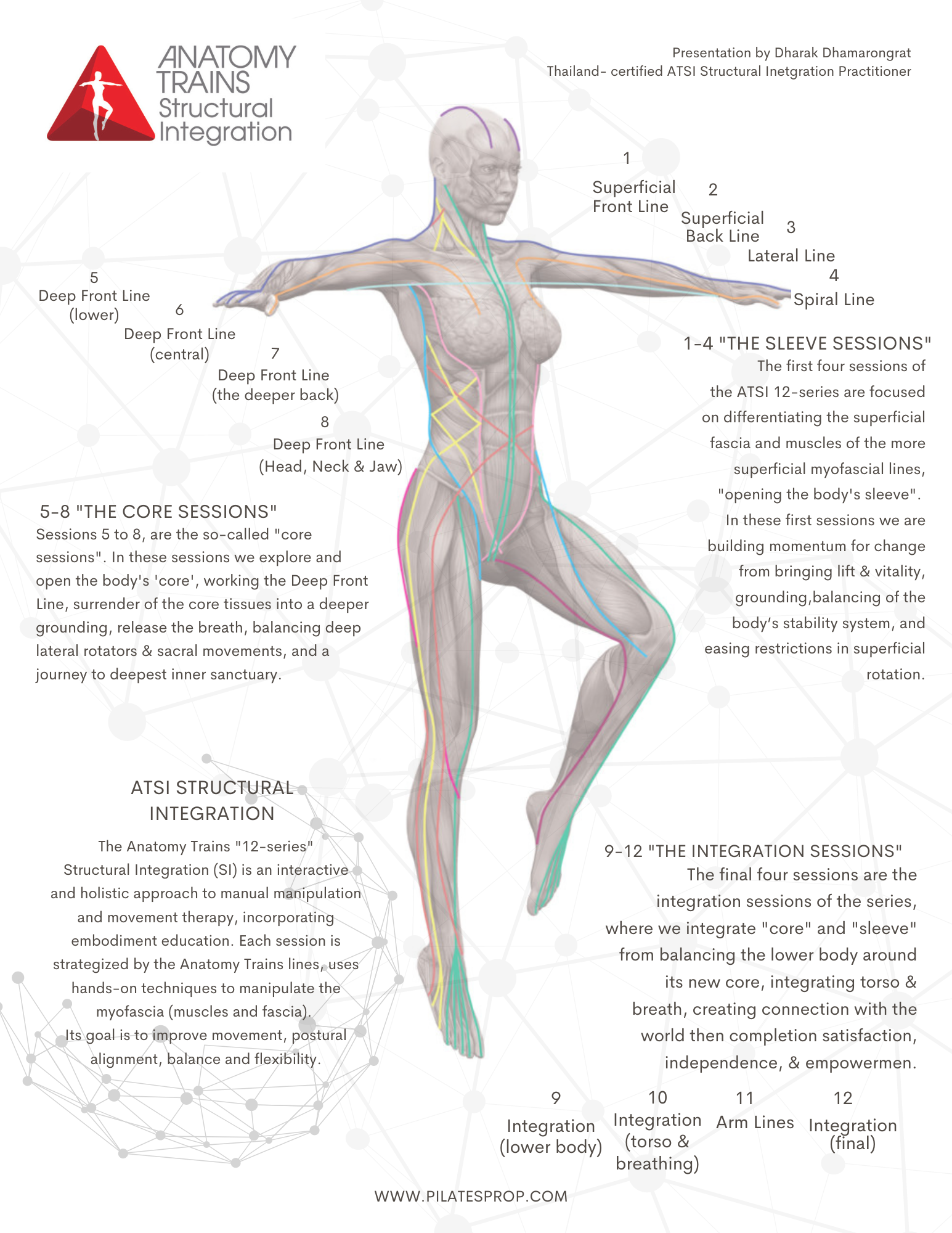
The first 4 sessions are known as the sleeve sessions. The aim is to free up the front, back and sides, freeing the shoulders from the trunk, freeing the breath and finding support through the feet.
The middle four sessions are known as the core sessions. They address the core of the body, working into the central stabilisation muscles closer to the spine helping to unwind hidden rotations and find support from within.
The final four sessions integrate the core and the sleeve to improve co-ordination and posture.
The new alignment simply becomes part of who you are, not something you have to work at or repeatedly see a practitioner to maintain – leaving you with a lasting and progressive change.
Credit:
https://www.anatomytrains.com/bodyworkers/
https://www.anatomytrainsaustralia.com;
https://balance-integrative-health-and-bodywork.au3
https://structuralbodywork.co.uk/anatomy-trains-myofascial-meridians/